Introduction
Starting a business in 2026 does not require a huge office, a large team, or a perfect idea. What matters most is solving a real problem for a specific group of customers and building a practical way to make money from that solution.
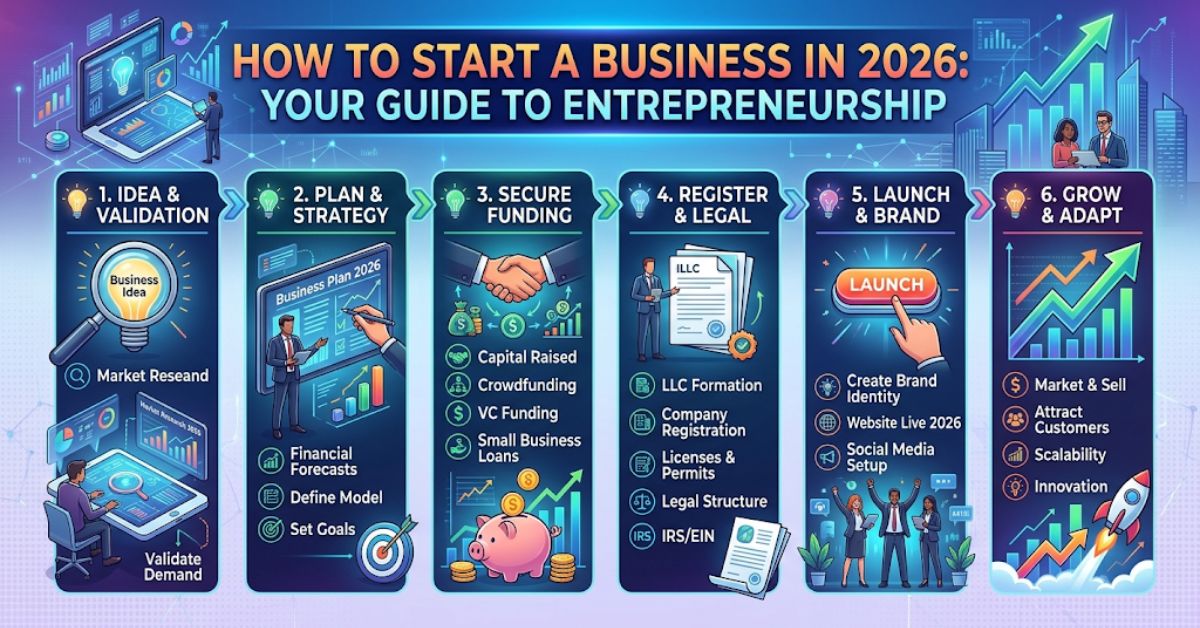
If you want to know how to start a business in 2026, begin with validation rather than spending heavily. Research your market, test whether people want what you plan to offer, estimate your costs, choose an appropriate business structure, and create a simple path to your first customers. Current small-business guidance continues to emphasize market research, planning, startup-cost estimates, legal setup, and customer acquisition.
Technology also gives new businesses more ways to work efficiently. AI tools are increasingly being used by small businesses for tasks such as marketing, communication, customer service, analytics, and productivity. The opportunity is not to use AI everywhere, but to use it where it genuinely saves time or improves the customer experience.
1. Start With a Problem Worth Solving

A strong business usually begins with a customer problem, not simply a product.
Ask yourself:
- What problem am I trying to solve?
- Who experiences this problem?
- How are people solving it today?
- What is frustrating or expensive about current solutions?
- Why would someone choose my solution?
For example, instead of starting with “I want to sell clothing,” narrow the idea to a specific customer and need. You might focus on affordable workwear for a particular audience or a convenient online ordering service for local customers.
The narrower the initial problem, the easier it can be to understand your customer and create a useful offer.
Look at your skills and resources
Your existing skills can help you choose a realistic starting point. Consider what you already know about:
- Writing
- Design
- Technology
- Marketing
- Education
- Food
- Local services
- E-commerce
- Professional services
You do not need to be an expert in every area. You need enough knowledge to understand the customer’s problem and either deliver the solution yourself or learn what is necessary to provide it.
2. Research the Market Before Spending Money

Market research helps you determine whether customers actually want your product or service. It should also help you understand competitors, pricing, customer behavior, and gaps in the market. ([Small Business Administration][1])
Start with simple research.
Identify your target customer
Define your ideal customer as specifically as possible.
Instead of:
Everyone who needs marketing
Try:
Small local businesses that need help getting customers through search and social media.
A clear audience makes your marketing, pricing, product development, and sales process much easier to plan.
Study competitors
Look at businesses already serving the market.
Compare:
- What they sell
- Who they target
- Their pricing approach
- Their customer reviews
- Their marketing channels
- Their strengths
- Their weaknesses
- Problems customers frequently mention
Do not copy competitors. Look for opportunities to serve customers differently or better.
Talk to potential customers
Online research is useful, but direct conversations can reveal problems that websites and statistics do not show.
Ask potential customers questions such as:
- What is the biggest problem you have with this?
- How do you solve it today?
- What do you dislike about your current solution?
- What would make a better solution valuable to you?
Listen for repeated problems rather than trying to convince people to buy your idea.
3. Validate the Business Idea Before Building Too Much
One of the biggest early mistakes is spending months building a product before discovering whether customers want it.
Instead, test the smallest realistic version of your offer.
This might mean:
- Creating a simple landing page
- Offering a basic service manually
- Selling a small initial batch
- Creating a prototype
- Taking pre-orders where appropriate
- Running a small marketing test
- Offering a pilot service to a limited group
The goal is to learn.
If people show genuine interest, you have evidence that the idea deserves further development. If they do not, you can change the offer before committing more money and time.
4. Create a Simple Business Plan
You do not always need a long formal document to begin. A practical business plan should explain how the business will work.
Cover these basic questions:
| Area | Question to answer |
|---|---|
| Customer | Who will buy from you? |
| Problem | What problem are you solving? |
| Offer | What exactly will you sell? |
| Value | Why should customers choose you? |
| Pricing | How will you charge? |
| Marketing | How will people discover you? |
| Sales | How will interest become purchases? |
| Costs | What will you need to spend? |
| Operations | How will you deliver the product or service? |
| Goals | What do you want to achieve first? |
Your first plan should be practical rather than impressive. You can improve it as you learn more about the market.
5. Calculate Your Startup and Ongoing Costs
Before launching, separate one-time costs from recurring costs.
One-time expenses may include:
- Equipment
- Initial inventory
- Website setup
- Branding
- Registration fees
- Initial professional services
Recurring expenses may include:
- Rent
- Software subscriptions
- Internet and communications
- Salaries or contractor payments
- Advertising
- Insurance
- Accounting
- Inventory replenishment
The amount required varies greatly by business model. A home-based service business can have very different startup needs from a restaurant, retail store, manufacturing operation, or technology company.
Do not spend heavily on things that do not help you validate the business or serve customers.
6. Choose the Right Business Structure
Your legal structure affects how the business is owned, operated, taxed, and regulated.
Depending on your country, common structures may include:
- Sole proprietorship
- Partnership
- Limited liability company or similar structure
- Private company
- Corporation
The right choice depends on your location, business activity, ownership arrangements, liability considerations, tax rules, and growth plans.
Do not choose a structure simply because another business uses it. Check the rules that apply where you will operate and consider professional legal or accounting advice when the decision is significant.
7. Register the Business and Handle Legal Requirements
Once you have validated the idea and chosen your structure, complete the registrations and permits required for your location and industry.
Requirements differ by country, region, business structure, and type of activity.
For example, in Pakistan, company incorporation is handled through the Securities and Exchange Commission of Pakistan (SECP), which provides online incorporation procedures. Tax registration requirements are handled through the Federal Board of Revenue (FBR), while some businesses may also need provincial or industry-specific licenses.
If you operate in Sindh, additional regulatory requirements can apply depending on your business activity; the Sindh government’s business portal provides tutorials covering different licensing and regulatory areas.
Check official government requirements before registering because fees, forms, tax rules, and licensing requirements can change.
8. Separate Business Money From Personal Money
Once the business starts handling money, keep business finances organized.
Depending on your structure and local requirements, this may involve opening a dedicated business bank account and maintaining separate records.
Track:
- Sales
- Expenses
- Invoices
- Receipts
- Taxes
- Supplier payments
- Customer payments
- Cash flow
Separating business and personal finances makes financial reporting easier and gives you a clearer picture of whether the business is actually making money.
9. Build a Simple Brand and Online Presence
You do not need an expensive brand package before getting your first customer.
Start with the basics:
- A clear business name
- A useful logo if needed
- Consistent visual identity
- A simple website or relevant online profile
- Clear product or service descriptions
- Contact information
- Pricing or a clear way to request pricing
- Customer-focused messaging
Your website should quickly answer three questions:
What do you offer?
Who is it for?
Why should someone choose you?
Do not let design work delay your launch. A simple, trustworthy presence is often more useful than a polished website with unclear messaging.
10. Create a Realistic Customer Acquisition Plan
A business needs customers, not just a product.
Choose marketing channels based on where your target customers actually spend time.
Possible channels include:
- Search engines
- Social media
- Content marketing
- Local partnerships
- Referrals
- Networking
- Marketplaces
- Direct outreach where appropriate
- Paid advertising
Start with one or two channels that fit your audience instead of trying everything at once.
For example, a local service business might benefit from local search visibility and referrals, while an online business might focus more heavily on content, social media, email, or partnerships.
The objective is to discover a repeatable path from attention → interest → purchase → repeat customer.
11. Use AI as a Business Tool, Not a Business Strategy
AI is becoming increasingly accessible to small businesses, but it should support a clear business goal rather than become the goal itself.
Useful applications can include:
- Drafting marketing content
- Organizing information
- Summarizing customer feedback
- Creating first drafts of documents
- Brainstorming ideas
- Analyzing business data
- Supporting customer-service workflows
- Automating repetitive administrative tasks
Recent research indicates that newer small businesses are adopting AI relatively quickly, while adoption and usefulness vary between businesses and industries.
Choose the Right Pricing Strategy
Pricing is one of the most important decisions when starting a business. A price that is too low can make it difficult to cover expenses, while a price that is too high can make it harder to attract your first customers.
Start by understanding three things:
- Your costs: What does it actually cost to deliver the product or service?
- Customer value: What problem does your offer solve, and how valuable is that solution?
- Market alternatives: What are customers already paying for similar solutions?
Do not automatically copy a competitor’s price. Two businesses can sell similar products but have very different costs, quality, positioning, and customer service.
Test pricing instead of guessing
Your first price does not have to be permanent.
You can test different packages or service levels, such as:
- Basic
- Standard
- Premium
For example, a freelance designer might offer a basic design package, a larger package with revisions, and a premium package that includes additional brand assets.
The goal is to find a price that customers understand and that gives the business enough room to operate sustainably.
12. Build a Small First Version of the Business
You do not need to launch everything at once.
A smaller launch can help you discover what customers actually want before you invest heavily.
For a service business, this might mean starting with one service instead of ten. For an online store, it could mean launching a focused product range instead of hundreds of products.
This approach makes it easier to:
- Launch sooner.
- Collect customer feedback.
- Identify problems.
- Improve the offer.
- Control early expenses.
- Understand what customers value most.
Your first version should be useful, not perfect.
13. Get Your First Customers
Getting the first customers can be harder than creating the business itself.
Start with people and channels that are most likely to understand your offer.
Use your existing network
Tell relevant people what you are offering. Friends, professional contacts, local businesses, community groups, and previous contacts may help you discover potential customers.
Do not rely only on people you already know. Use your network as a starting point for introductions and feedback.
Offer a clear reason to respond
A vague message such as “I have started a new business” gives people little reason to take action.
Instead, explain:
- Who you help
- What problem you solve
- What you offer
- What the next step is
For example:
“I help small businesses improve their online presence with simple website and search optimization services. I’m currently offering an initial consultation for businesses that want to identify their biggest online visibility problems.”
Clear messaging makes it easier for the right person to understand your offer.
14. Track Cash Flow From the Beginning
Profit and cash flow are not the same thing.
A business can appear profitable on paper while still having difficulty paying bills because money has not arrived when expenses are due.
Track:
- Money coming in
- Money going out
- Payment dates
- Outstanding invoices
- Recurring expenses
- Inventory purchases
- Taxes and other obligations
A simple spreadsheet can be enough for a very small operation at the beginning. As the business grows, accounting software or professional bookkeeping support may become more useful.
The key is to know what money is available before making new spending commitments.
15. Protect the Business From Avoidable Problems
Starting a business involves uncertainty. You cannot remove every risk, but you can reduce avoidable ones.
Depending on the business, consider:
- Appropriate insurance
- Written agreements
- Clear refund and cancellation policies
- Secure handling of customer information
- Reliable payment processes
- Supplier alternatives
- Proper record keeping
- Compliance with applicable laws and licenses
Do not use a generic online document without checking whether it fits your situation. Important contracts, employment arrangements, intellectual-property issues, and regulatory matters may require qualified professional advice.
16. Measure What Actually Matters
New business owners can easily become distracted by numbers that look impressive but do not show whether the business is healthy.
Instead of focusing only on followers, website visits, or likes, track metrics connected to business outcomes.
Useful measures can include:
- Number of qualified leads
- Conversion rate
- Average order value
- Repeat purchases
- Customer acquisition cost
- Revenue
- Gross margin
- Cash available
- Customer retention
The right metrics depend on the business model.
For example, an online store may care heavily about conversion rate and repeat purchases, while a consulting business may focus more on qualified leads, proposal conversion, project value, and client retention.
17. Common Mistakes to Avoid When Starting a Business in 2026
Spending too much before validating demand
A professional website, office, equipment, or large inventory will not solve a weak business idea.
Validate demand first.
Trying to serve everyone
A broad audience can make your marketing unclear. Start with a specific customer group and expand once you understand the market.
Choosing a business idea only because it is trending
Trends can create opportunities, but a trend alone does not guarantee a sustainable business.
Ask whether customers have a continuing problem that your business can solve.
Ignoring the numbers
Revenue is not the same as profit, and profit is not the same as available cash.
Understand your costs and cash position from the beginning.
Depending entirely on one platform
If all your customers come from one social network, marketplace, or advertising channel, changes to that platform can affect your business.
Build relationships with customers and develop more than one reliable acquisition channel over time.
Waiting for everything to be perfect
Perfection can delay learning.
Launch a useful first version, gather feedback, and improve based on what you learn.
18. A Practical 90-Day Business Launch Plan
If you want a simple starting roadmap, divide the first three months into three stages.
Days 1–30: Research and validation
Focus on:
- Choosing a specific problem
- Defining your target customer
- Researching competitors
- Talking to potential customers
- Testing your offer
- Estimating startup and operating costs
- Checking relevant legal requirements
Your main goal is to determine whether the idea deserves further investment.
Days 31–60: Build the foundation
Focus on:
- Choosing the business structure
- Completing necessary registrations
- Setting up financial records
- Creating your basic brand
- Building a simple online presence
- Finalizing your initial offer
- Setting pricing
- Preparing a customer acquisition process
Keep the setup proportional to the size of the business.
Days 61–90: Launch and learn
Focus on:
- Finding your first customers
- Delivering the offer
- Collecting feedback
- Tracking revenue and costs
- Measuring marketing results
- Fixing operational problems
- Improving your offer
At the end of the first 90 days, you should have more evidence about what works than you had when you started.
19. Know When to Adapt or Change Direction
Not every business idea works exactly as planned. Early results can show that your customers, pricing, product, or marketing approach needs adjustment.
Pay attention to signals such as:
- Customers repeatedly asking for a different solution
- People showing interest but not purchasing
- A product taking too much time to deliver
- Marketing producing attention but few qualified leads
- Costs consistently being higher than expected
- One particular customer segment responding much better than others
Changing your approach is not automatically a failure. It can be a normal part of building a business.
The important thing is to make changes based on evidence rather than constantly changing direction without learning from the results.
20. How to Start a Business in 2026 With Limited Money
You can reduce the financial risk of starting by choosing a business model that fits your available resources.
Service businesses are often easier to test with limited upfront spending because you may be able to sell a skill before investing in inventory or physical infrastructure.
Possible examples include:
- Freelance writing
- Graphic design
- Web development
- Tutoring
- Consulting
- Digital marketing
- Video editing
- Local professional services
This does not mean every service business is inexpensive or automatically profitable. Your skills, market, equipment, customer demand, and operating costs still matter.
If your idea requires significant capital, create a realistic funding plan before committing to major expenses. Depending on your circumstances and location, funding could come from personal savings, business revenue, loans, investors, grants, or other legitimate financing options.
21. Keep Improving After Launch
Launching is the beginning of the business, not the finish line.
After you start getting customers, continue asking:
What should I keep?
What should I improve?
What should I stop doing?
Use customer feedback, financial results, and operational data to make decisions.
Over time, you may discover opportunities to:
- Improve the product
- Raise or restructure pricing
- Reduce unnecessary expenses
- Serve a more profitable customer segment
- Add complementary services
- Improve customer retention
- Automate repetitive work
- Expand into another market
Growth should follow evidence. Expanding too quickly can create unnecessary operational and financial pressure.
FAQs
How much money do I need to start a business in 2026?
There is no single amount that applies to every business. A digital service business may require relatively little upfront capital, while a restaurant, retail operation, or manufacturing business can require substantially more.
Estimate your specific one-time and recurring expenses before deciding how much funding you need.
What is the best business to start in 2026?
There is no universally best business. A strong opportunity is one where you understand the customer, can solve a meaningful problem, have a realistic way to reach buyers, and can operate within your available resources.
Can I start a business from home?
Yes, many businesses can begin from home, particularly online and service-based businesses. However, local zoning, licensing, tax, registration, and industry requirements may still apply.
Should I create a business plan before starting?
Yes. Even a short plan can help you clarify your customer, offer, pricing, costs, marketing approach, and financial goals. The plan should be useful for making decisions rather than simply being a document you never revisit.
Is AI necessary for a new business in 2026?
No. AI can help with certain tasks, but it is not a requirement for starting a business. Choose technology based on whether it solves a real operational or customer problem.
What should I do if my first business idea does not work?
Find out why it is not working before abandoning it. Customer feedback may reveal that you need to change the target market, offer, price, distribution channel, or business model. If the evidence shows the opportunity is weak, moving to a different idea can also be a sensible decision.
CONCLUSION
Starting a business in 2026 is less about having a perfect launch and more about making smart decisions in the right order.
Start with a real customer problem. Validate the demand before making major investments. Build a simple offer, understand your costs, complete the required legal setup, and develop a practical way to reach customers.
Once the business begins operating, let customer feedback and financial results guide your next decisions. A small, well-tested business can give you a much stronger foundation than a large launch built on assumptions.